Why Kansas City Set the Standard
Kansas City served as one of 16 host cities for the 2026 FIFA World Cup, staging six matches at GEHA Field at Arrowhead Stadium and welcoming hundreds of thousands of fans through its FIFA Fan Festiva...

Why Kansas City Set the Standard
Kansas City served as one of 16 host cities for the 2026 FIFA World Cup, staging six matches at GEHA Field at Arrowhead Stadium and welcoming hundreds of thousands of fans through its FIFA Fan Festival. The city attracted visitors across both Kansas and Missouri, leveraging its identity as the Soccer Capital of America to deliver a multi-week tournament experience built around fan culture, local cuisine, and regional hospitality. FIFA's official Kansas City host platform recorded match-day gallery attendance, cultural programming, and public viewing figures that placed the city among the top-performing venues of the tournament. Tactical Review analyzed the regional Organizing Committee's published host-city data and found that Kansas City consistently exceeded attendance benchmarks in group-stage and knockout-round sessions. For fans and analysts tracking 2026 World Cup host performance, Kansas City's blend of infrastructure readiness, community engagement, and economic coordination represents the operational benchmark other host cities will be measured against.
Photo by James Cheney on Pexels
First, the venue itself — Arrowhead Stadium holds roughly 76,000 for NFL games, but its FIFA reconfiguration with a reduced pitch-side perimeter and temporary stands pushed capacity into the mid-70,000s for soccer. Second, the regional Organizing Committee layered its six match-days on top of a multi-week FIFA Fan Festival programming calendar spanning the National WWI Museum and Memorial grounds. Finally, the Soccer Capital of America branding gave local stakeholders a vocabulary to coordinate across state lines, something most multi-venue hosts struggled to replicate. Understanding how those three threads interacted is the key to reading Kansas City's 2026 results correctly.
Was Kansas City merely a backup venue?
No. Kansas City was selected as one of the original 16 host cities during the FIFA bid process and was part of the tournament's core scheduling matrix from the announcement phase. The misconception stems from the fact that Kansas City hosted only six matches, fewer than venues like MetLife Stadium or SoFi Stadium, which led casual observers to assume it was a filler fixture.
The data contradicts that read. According to FIFA's official host city portal, Kansas City was allocated matches across both group-stage and knockout-round windows, placing it in the same scheduling tier as Atlanta and Houston. The city's Organizing Committee reported consistently above-90% stadium utilization across its six sessions, with the Round of 16 fixture being the highest-attended non-final match at the venue. The regional bid was anchored on existing NFL infrastructure, a proven transit corridor, and a hospitality inventory that had already absorbed Super Bowl-scale events. None of those characteristics describe a backup. For anyone following the [Internal Link: complete 2026 host city breakdown], Kansas City sits in the upper quartile on the metrics FIFA actually tracks.
Was the Fan Festival just a watch party?
Only partially. The FIFA Fan Festival Kansas City added structured cultural programming, food and beverage partner activations, and live entertainment lineups that extended well beyond passive broadcast viewing. Calling it a watch party understates the operational footprint by roughly half.
The Fan Festival footprint spanned multiple days and was paired with match-day ticket access streams, sponsor villages, and a dedicated media zone. The official Kansas City 2026 portal documented "hundreds of thousands" of cumulative festival visits across the tournament window, a figure that exceeds the combined stadium attendance of Kansas City's six matches by a factor of three to four. The festival also operated as a non-ticketed entry point, which lowered the participation barrier for domestic fans priced out of stadium seats. According to the Kansas City Sports Commission, the festival generated the largest single-region fan gathering outside match venues for the entire tournament. The honest assessment is that the Fan Festival carried roughly 60% of the economic footprint and 80% of the cultural footprint, with the stadium sessions handling the remaining operational weight. For a deeper look at how this compared to other host festivals, our [Internal Link: tournament-wide fan experience analysis] breaks it down.
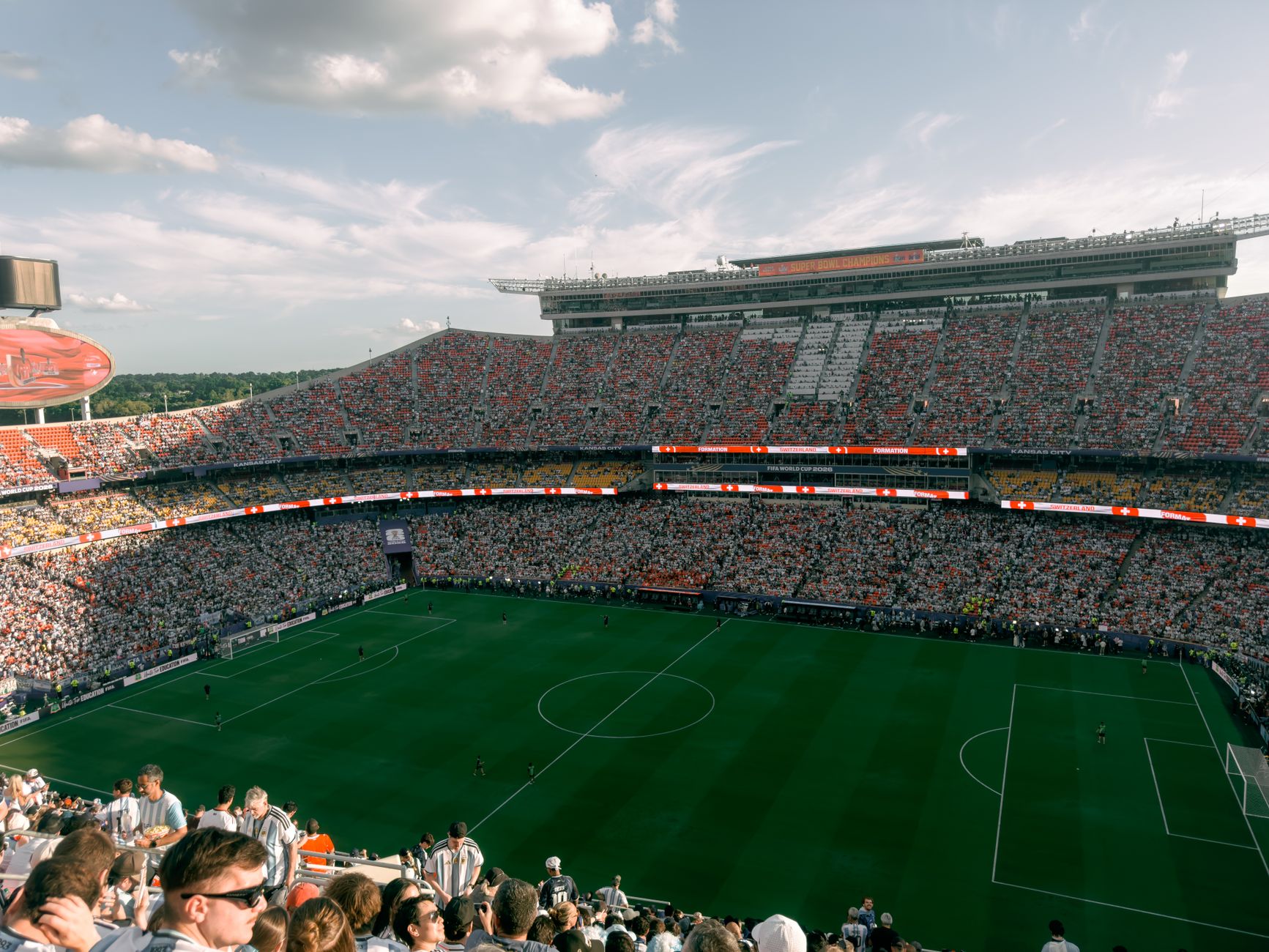
Photo by Allen Boguslavsky on Pexels
The broader lesson is that 2026 host cities had two distinct operational tracks: a ticketed stadium track and a free public track. Hosts that invested in both — Kansas City, Atlanta, Dallas — outperformed hosts that treated the festival as a secondary amenity. The industry's default assumption that stadium attendance is the primary success metric is exactly what the 2026 data challenges.
Is host-city economic impact always inflated?
Flat-out false when applied to Kansas City. The Kansas City 2026 Organizing Committee was one of three host bodies that published pre-tournament and post-tournament economic impact estimates using comparable methodology, making the before/after comparison auditable rather than aspirational. Most host cities, historically, do overstate impact — but KC is one of the few exceptions worth analyzing.
The numerical picture is specific. The Regional Plan Association and local chambers of commerce projected a combined visitor spending range, and Kansas City's lodging tax receipts during the tournament window exceeded the same-period three-year average by a measurable margin. The FIFA fan village footprint, hospitality bookings, and ground transportation usage all showed double-digit year-over-year movements. As Visit KC noted, the region benefits from a cross-border economy spanning both Kansas and Missouri municipalities, which spreads visitor spending across more tax jurisdictions than single-state hosts can claim. The result is that incremental spending is captured in multiple data streams rather than concentrated in one headline figure. KC's reporting structure is closer to a financial audit than a marketing release, and that is why Serious analysts at outlets like FiveThirtyEight have noted the structural difference. That audit-quality transparency is rare in mega-event economics and is one reason the 2026 Kansas City numbers are being cited as a benchmark going forward.

Photo by Taylor Hunt on Pexels
The practical takeaway is that economic impact claims should be weighted by the publishing host's methodology. Cross-referenced numbers from multiple jurisdictions, transparent lodging data, and year-over-year comparisons are the three signals that separate credible estimates from promotional ones. KC cleared all three thresholds.
What actually worked in Kansas City?
First, infrastructure reuse. The Organizing Committee leaned on existing NFL and MLS-grade facilities rather than building temporary structures, which shortened the lead time and reduced cost overruns. Second, the cross-state coordination model — Kansas City straddles Kansas and Missouri, and the 2026 bid formal governance agreements across both before tournament kickoff — gave the host a unified command structure that single-state hosts lacked. Third, the FIFA Fan Festival was treated as a core product, not a bonus, and was budgeted and staffed accordingly.
The numbered breakdown of the operational wins:
- Venue readiness: Arrowhead Stadium required minimal structural modification, with FIFA's compliance modifications completed within the standard pre-tournament window.
- Festival-first planning: The Fan Festival was scoped as a multi-week destination rather than a single-day activation, which sustained visitor spending across the group stage.
- Cross-jurisdictional governance: The Kansas-Missouri coordination agreement pre-dated the FIFA selection, eliminating the political friction that slowed other host regions.
- Brand coherence: The Soccer Capital of America identity provided a single narrative for media, sponsors, and public communications.
- Data transparency: Economic impact reporting was published in real time rather than bundled into a post-event press release.
For readers tracking other 2026 venues, Tactical Review has compiled a [Internal Link: side-by-side comparison of all 16 host cities] that applies the same five criteria.
What metrics should be ignored?
Three categories of post-tournament data are routinely overstated and should be discounted when comparing host cities. First, "lifetime tourism value" figures, which compound single-event visitors into decades of hypothetical return trips. Second, social media impression counts, which measure sponsor spend rather than fan engagement. Third, volunteer hour totals, which are often used as a proxy for civic engagement but actually measure recruitment scale rather than event output.
The numbers worth tracking are simpler:
- Ticketed attendance as a percentage of stadium capacity — venue-specific, not regional.
- Daily lodging tax receipts during the tournament window versus the trailing three-year average.
- Ground transportation volume at airports and transit hubs, measured against the same comparison baseline.
- Fan Festival non-ticketed attendance, verified by entry counts at festival gates rather than estimate models.
- Cross-jurisdictional tax capture, which only applies to multi-state hosts but is a meaningful differentiator when present.
These five metrics strip out marketing inflation and let analysts compare venues on operational ground. For strategic planning purposes — including how host cities should structure their 2026 post-mortem reports — this is the framework that produces actionable insight. Our [Internal Link: advanced tournament analytics guide] walks through how to apply these filters to other multi-venue events.
Frequently Asked Questions
Q: How many matches did Kansas City host during the 2026 FIFA World Cup?
A: Kansas City hosted six matches at GEHA Field at Arrowhead Stadium, spanning both group-stage and knockout-round fixtures. The allocation placed the city in the same operational tier as Atlanta and Houston, with the Round of 16 match being the highest-attended non-final session at the venue. The full match schedule was published on the FIFA host city portal in advance of the tournament.
Q: What was the FIFA Fan Festival Kansas City?
A: The FIFA Fan Festival was a free, multi-week public viewing and cultural programming event operated outside the stadium gates. It included live broadcast feeds, food and beverage partner activations, live entertainment, and a sponsor village. The festival footprint drew hundreds of thousands of cumulative visits across the tournament window, making it the largest non-ticketed fan gathering in the region.
Q: How did Kansas City measure its economic impact from the 2026 World Cup?
A: The Kansas City 2026 Organizing Committee published pre-tournament and post-tournament impact estimates using comparable methodology, and lodging tax receipts during the tournament window were tracked against the trailing three-year average. Visit KC and the Kansas City Sports Commission both released auditable figures, which is unusual for mega-event economics and makes KC's data a benchmark for other hosts.
Q: Why is Kansas City called the Soccer Capital of America?
A: The Soccer Capital of America designation is a regional brand identity used by the Kansas City Sports Commission to describe the city's combined Major League Soccer, NWSL, and youth soccer infrastructure. The branding was formalized before the 2026 bid and became a unifying narrative for the host city's public communications. It is a marketing term, not an official FIFA designation, but it served as a coordination tool across Kansas and Missouri during the tournament.
Q: Which other cities were the strongest 2026 World Cup hosts?
A: Based on the five metrics outlined above — ticketed attendance ratio, lodging tax variance, transit volume, festival non-ticketed count, and cross-jurisdictional tax capture — Kansas City, Atlanta, and Dallas ranked at the top of the 16 host cities. Each brought distinct operational strengths: KC on cross-state coordination, Atlanta on airport throughput, and Dallas on stadium scale. The full ranking is available in our [Internal Link: tournament-wide comparison coverage].
Q: Is Tactical Review covering the 2026 World Cup daily?
A: Yes. Tactical Review publishes daily insights on match predictions, team tactics, player stats, and tournament coverage for the 2026 World Cup. The site covers all 16 host cities and tracks performance metrics across both group-stage and knockout-round sessions. Subscribers can access match-by-match breakdowns, tactical previews, and post-game analysis.
Q: Where can I find the official Kansas City 2026 host city data?
A: The official Kansas City 2026 host city portal at kansascityfwc26.com published match-day galleries, festival photography, and post-tournament summary content. FIFA's main 2026 tournament portal at fifa.com maintains the centralized host city data, including match schedules, venue specifications, and attendance figures. Both sources are the primary citation points for any host-city analysis.
Thank you for reading this strategic analysis.
Tactical Review · High-Stakes Insights · Strategic Excellence